To see other Quarantine posts, visit my quarantine page.
With all the talk about Chlorquine Hydochloride and the brewing controversy surrounding New York Governor Cuomo’s refusal to use it versus President Trump’s insistence that “what have you got to lose,” I became curious about what this drug is, how it works in our body, and why it seems so controversial. But first a disclaimer, I’m not a medical expert in any regard, not my swim lane. I’m simply someone who wants to better understand any potential mitigation measures. What follows are “just the facts Ma’am,” as I found them.
History: The basis for Chlorquine Hydochloride is quinine. If you’ve ever heard of quinine before it was probably while looking at the label on your bottle of tonic just before pouring yourself a ‘gin and tonic,’ at least that’s how I first heard of it back in high sch-, I mean, college. Quinine is derived from the bark of the cinchona tree, which is indigenous to an area around Peru, South America. It’s first known European use was in 1631 in Rome where it was brought by Jesuits Priests to help cure chills, fever, and muscle aches. At that time, quinine was called, “Jesuit Bark.”
The Cinchona tree did of course have a different name to folks indigenous to Peru, but was named in Europe after the wife of a Spanish viceroy to Peru. Her name was Countess Anna del Chinchón who was cured of malaria (called ague by locals), in 1638. After years of scandalous plagiarism and out right theft of intellectual property, two French researchers in 1820, separated the alkaloid powder from the cinchona bark and named it quinine.
While Inca and other South American tribes had been using cinchona bark to treat shivers, relax muscles, and cure ague for centuries, it wasn’t until the early 1800’s that Europeans “discovered” this miraculous anti-malaria drug, which they then widely used during Europe’s brutal colonization of Africa and Southeast Asia. To get soldiers to take the bitter cinchona extract, it was mixed with sugar and water, which is where the aforementioned tonic water was derived. To ensure they took their medicine, this quinine based sugar water was mixed with a soldier’s daily ration of gin and thus began a wonderful tradition.
In 1944, American ingenuity stepped up to help US sailors and marines in the South Pacific, who were liberating island nations from the scourge of Japanese aggression while fighting armies of both men and mosquito. American researchers developed chloroquine, which is a synthetic replacement for natural quinine. Chloroquine does not have the same levels of neurotoxicity as found quinine. In other words, it can be taken more often at higher doses with fewer side effects. Notice I did not say no side effects, which is where Governor Cuomo comes in with his concerns.
Note to gin and tonic drinkers: Today you can still find quinine in tonic water but at low doses. While quinine has the positive attribute of being a muscle relaxant and does indeed help in your ongoing struggle to prevent malaria, it’s a neurotoxic drug, which when taken in excess can cause all kinds of bad juju. Tell the truth, you knew all along the miracle of modern pharmacology was too good to be true.
How Chloroquine works: Chloroquine does not prevent malaria but rather stops the growth of the parasite in your body by preventing it from attaching to red blood cells. Chloroquine hydrochloride is the most popular version of this synthetic drug today and is effective against most malaria strains. Chloroquine hydrochloride can cause retinal damage in some people and if over done, can even cause death (ref. Drugs.com).
During the 1960’s, new strains of malaria began to emerge which were impervious to the synthetic Chloroquine hydrochloride (ref. Encyclopedia Britannica). However, natural quinine continued to be effective, something to which any of the fine folks casually perusing Whole Foods or Trader Joe aisles would just knowingly nod and say, “but of course.”
What else in nature works like Chlorquine Hydochloride: FYI, the bit just before about folks at Whole Foods was what writers like to call foreshadowing. The pharmaceutical industry long ago learned to exploit nature for medicinal purposes. The base ingredient for many prescription and over the counter drugs are found in nature. For example, aspirin is derived from tree bark. The drug used to treat ovarian cancer comes from the Yew tree and of course there is quinine from the cinchona tree.
Another natural agent hard at work on your behalf is quercetin, a “common plant pigment (i.e., flavonoid) found in foods, such as red wine, onions, green tea, apples, berries, Ginkgo biloba, St. John’s wort, American elder, and others. Buckwheat tea has a large amount of quercetin.” (ref. WebMD). The proported beneficial effects of quercetin are widespread, including killing cancer cells, treating diabetes and autism, and repairing damaged muscles. Now’s the time to fondly remember your Mom shaking her wooden spoon at you saying “eat your vegetables.”
Quercetin is both an antioxidant and an anti-inflammatory agent that helps reduce inflammation. In a 2013 paper S. Mishra, P. Singh, and S. Rath, studied the positive effects of quercetin to help minimize the negative side effects of chlorquine hydochloride. Keep this in mind if in the coming weeks you find yourself on a chlorquine hydochloride regiment.
Leap of Faith: Here’s were our story requires a leap of faith, one President Trump is willing to make, but New York Governor Cuomo is not. To begin with, in studies conducted both recently and dating back to the SARS pandemic, zinc has been shown to inhibit the growth of coronaviruses. The problem is that zinc cannot penetrate the cell membrane of COVID-19. In 2003, a Canadian team led by Michel Chrétien and Majambu Mbikay, found that quercetin weakens coronavirus cell membrane enough to permit zinc to get inside and go all Rambo on the virus. Based on that research, a French team of scientist recently discovered that chlorquine hydochloride combined with zinc had the same D-day effect on COVID-19. This then is what convinced doctors Anthony Fauci and Deborah Brix of the White House Coronavirus Task Force to promote its potential and President Trump to assert, “what have you got to lose?” Governor Cuomo continues to believe the negative side effects of chlorquine hydochloride are not outweighed by it’s positive potential. I predict whoever is right about the use of chlorquine hydrochloride will be our next president.
One Two Punch: Chlorquine hydochloride combined with zinc provides a one two punch that attacks COVID-19 cells the same way chlorquine hydochloride attacks malaria cells. Taking chlorquine hydochloride for malaria does not prevent infection but rather significantly reduces the effects. Similarly, chlorquine hydochloride in combination with zinc won’t prevent you from getting COVID-19, it may however reduce its effects.
Further observational evidence: A form of chlorquine hydochloride is routinely prescribed to people with rheumatoid arthritis. This week, a New York medical doctor on the front lines of patient care observed that none of the positive COVID-19 patients on rheumatoid arthritis medications required critical care. Does this definitively prove anything? No, but remember, John Snow who founded modern epidemiology, began by simply observing that the people getting cholera in London all drank water from the same contaminated well.
What you can do: Well for starters, listen to your Mom for once in your life. Remember this entire notion of using anti-malaria drugs to treat COVID-19 began with a couple of Canadians in 2003 looking at the positive impacts of quercetin on coronaviruses (like the common cold). So make some buckwheat tea (I know yuck, right), eat some broccoli, have a glass of red wine, eat lots of nuts (better source for zinc than multi-vitamins), and remember what Ben Franklin said, “an apple a day keeps the doctor away.” Also, and this will be hard for folks in the Dakotas and Wyoming, hook up with a vegetarian at Whole Foods who can teach you crazy stuff like pumpkin seeds have a boatload of zinc.
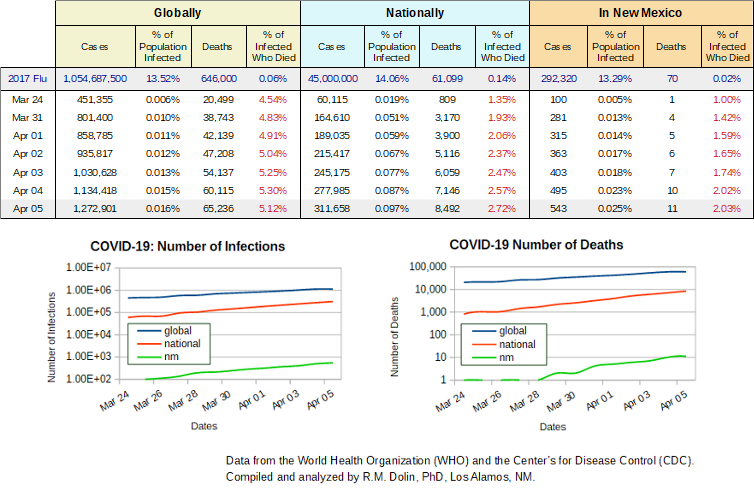
Note about the charts: When I started my pandemic blog, I plotted the rates of change for both COVID-19 infections and deaths. At that time, these were the important metrics to track because they portended what was coming. Today I switched to plotting the numbers of infected and dead, and had to use logarithmic scales to capture the global, national, and New Mexico numbers on each chart. This is not a good sign.

Comments are closed