Short Story by R.M. Dolin, October 12, 2025
Code of the West
It’s nostalgically convincing to surmise life in West Texas is not nearly as hard now as it was two-hundred years ago when early Anglo settlers first moved in along the Rio Grande border a little north of the Big Bend that now separates America from Mexico. The argument’s compelling, we have modern homes with heat, air conditioning, running water, and sewer lines that render their contents an afterthought.
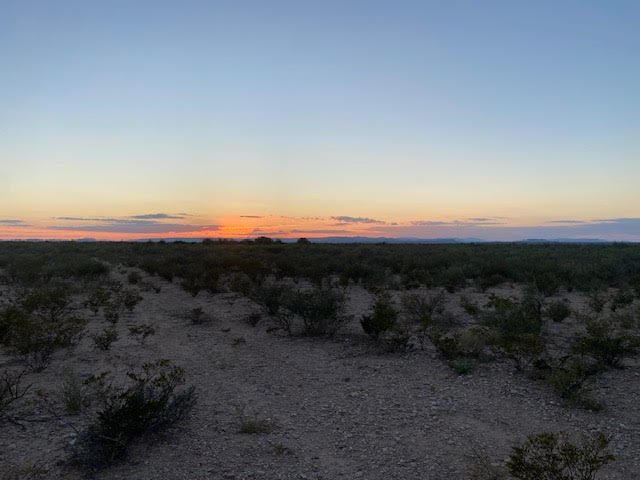
We have power lines delivering dependable electricity and solar panels for off-grid areas whenever the desert sun decides. We dine on processed food to enjoy year-round treats and use satellites to provide Internet and streaming media for entertainment. We have pickup trucks for getting around and washing machines that permit the occasional change into clean clothes. And let’s not discount our all-important stoves for cooking requisite morning coffee and evening dinner.
In many ways though, things are remarkably unchanged, there’s still no way to escape the extreme heat of a desert day, the scarcity of water, the power of wind, and the duality of rain that simultaneously provides life while delivering destruction. The pain of mesquite thorns is as unforgiving now as they ever were and the way earth still does what it wants when it wants, including opening up vast chasms in the ground that swallow trees, brush, and even pickups without warning leaves no doubt as to who’s in charge. The battle between man and nature still leans in favor of nature causing man to step back in respectful wonder whenever death comes calling, whether in the gliding cascade of circling buzzards or the hissing siren of a big cat taking down a darting deer, life remains fragile and firmly within nature’s domain.
It’s difficult for people living in the causal comfort of concrete covered cities to appreciate what it means to face death daily and to discount the many times you walk away from something that could have easily ended with your demise. Thus was the case with my last visit to West Texas when invited to join Nick and Jake on their elk hunt. The sad reason New Mexican’s hunt in Texas is because New Mexico no longer caters to its citizen. In a brazen bit of systematic corruption from a state conspicuous for corruption, politicians ensure that over half of the elk permits available each season are automatically allocated to wealthy landowners/donors who in turn sell them to rich East Coasters for upwards of ten thousand dollars each. Then, wealthy landowners/donors compete with average New Mexicans for the few remaining elk tags and to no one’s cynical surprise, they manage to secure most of those.
Since elk tags are over the counter in Texas, this is where non-wealthy New Mexicans must go if they want to hunt. I appreciated the boys inviting me down from Santa Fe even though I have no desire to bag an elk, my interest is in seeing how West Texans manage off-grid ranching since I’m contemplating finding a piece of undeveloped land somewhere along a lake or river and setting myself up for a self-sustaining life. My contribution to our crew is my expertise in field dressing large game and butchering meat into useful steaks, roasts, and trim that I’ll process for jerky, sausage, hamburger, and salami.
The five-hundred-and-forty-seven mile drive down from Northern New Mexico, takes me through Albuquerque along I-25, past the emptiness of Socorro, the desolation of Las Cruces, and the desperation of El Paso, before driving deep into the West Texas desert where ranches are measured in the thousands of acres, towns by the size and quality of the high school football stadium, and the distant horizon by the bare rock mountains rising up from the flat valley floor like a border wall protecting everything that once was from the persistent pressure of people and their problems.
The story I’m about to tell, I tell exactly as it happened without embellishment. You’ll be tempted to believe there’s no way it’s really true, that the confluence of events could never have so succinctly aligned, but I assure you, it really did go down this very way, and if you don’t believe me, get your lazy ass off your beer-stained couch and head down to West Texas along the Mexican border near Big Bend and see for yourself.
It’s early October, which in West Texas means days are still blistering hot with night offering only modest relief. The elk are in full rut with bulls bugling their warning to all challengers within a multi-mile radius. Feral hogs look for bogs to wallow before rutting around dense mesquite groves in the vein hope of finding shade and morsels of food. Dry desert dust kicks up from any kind of traffic, whether it’s wild game, domestic herds, or man on the prowl in pickups.
The Broken Ladder ranch thirty miles east of Alpine covers nine square miles of flat arid terrain, which in West Texas where they measure ranches relative to the size of Maryland, is a damn small spread. What Broken Ladder does have, that many larger ranches lack, is available water. There’s a well in the center of the property that’s only a hundred-and-thirty feet deep. A pump is used to push water to all areas of the ranch through irrigation lines that crisscross the property like a well-laid city grid. The pump used to work off a hundred-year-old windmill, but it blew down in a West Texas storm several years ago and was replaced by a modern solar powered system. While one can’t argue against the efficiency and effectiveness of a solar powered pump in the desert, there’s a certain charm to windmills that tilts toward the ruggedness of the harsh conditions it stands in defiant opposition to. There are four man-made dams that locals call tanks on the ranch that each capture and hold enough rain to provide precious water most of the year.
West Texas soil is not really dirt and not really clay or sand either; it’s a soft silty settling of dust that never really forms a crust so whenever the wind blows, which it tends to do most of the time, dust is more than willing to drift along to its next new destination. The soil has the texture and consistency of powdered sugar and the blueish tan tone of a Hantavirus mouse. Occasional clumps of buffalo grass scattered about hint at the land being tamable, but mostly it’s tumbleweeds, sagebrush, and mesquite that thrive, and of course whatever the hell you call that weed producing goatheads; Satan’s contribution to creation. The bastard plants produce seeds looking like thumbtacks that pierce the soles of your boots to get carried inside the house where they dislodge so you can later step on them at night during your barefoot walk to the bathroom. Nothing wakes you up with more clarity than trying to pee while picking thumbtacks from the bottom of your foot in the dark doing your best not to use words that’ll offend God.
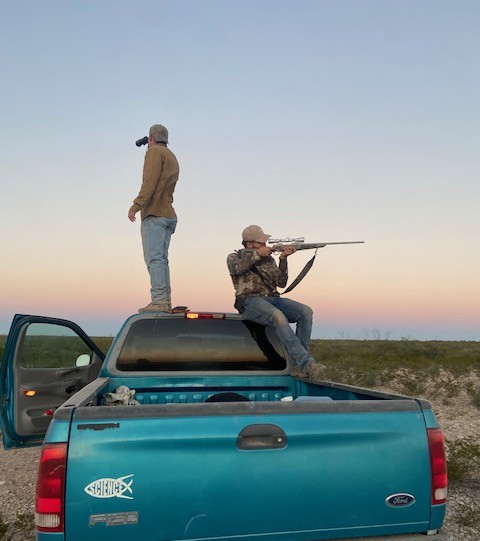
Nick and Jake get to Broken Ladder a day ahead of me. They came over from Las Cruces because university students need adventure and it’s a long weekend due to the Columbus/Founders/Indigenous-Peoples/Underworked-Government-Workers-Need-A-Day-Off holiday. Lance, who’s just inherited his boyhood home, came several days ago to decide how best to begin his management era but opted to stay in town at his dad’s old house. The boys set up camp in an empty concrete tank next to the tipped-over windmill. The tank has six-foot high walls around a twenty-foot diameter base. Their logic makes perfect sense, it’s out of the wind and dust, and away from hogs, snakes, and whatever else likes to lurk about at night. In the center of the base, they put a cut out metal drum with a grate on top for cooking and haul in mesquite wood for fuel. After transferring gear from Nick’s truck, they decide to use the dwindling light to scout around and get a feel for tomorrow morning’s hunt.
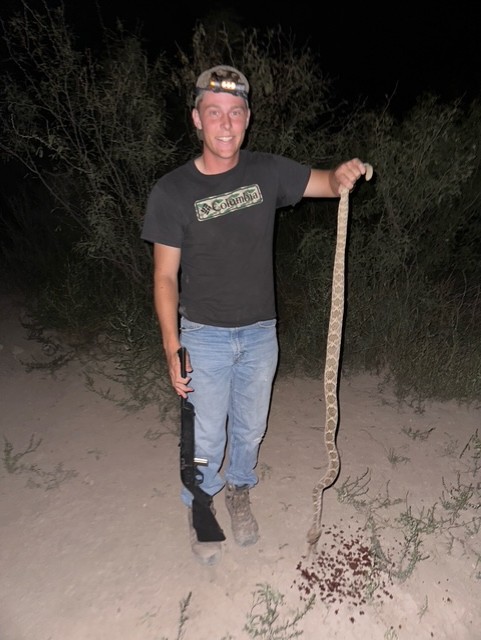
As they leave camp along a game trail next to the twenty-foot-long trough filled to overflowing with well water, Nick steps over a tumbleweed blown against the tipped over windmill and hears the sudden and all too familiar rattle of a snake in the bush. With the instincts of a wide receiver, he leaps into the air just as the rattlesnake springs toward him, and with the calm pocket presence of his high school quarterback, Jake levels his 22 caliber semi-automatic rifle and puts three rounds into the snake before he can launch a second strike.
The next morning when Lance and I arrive, the boys proudly show us their five foot snake skin stretched out to dry on a weathered two-by-ten and talk with disgust about how the snake they roasted over their mesquite fire in a cut out metal drum tasted like piss soaked in vinegar causing them to accuse me of making up the stories they grew up hearing about how I ate rattlesnakes as a boy in South Dakota. All I can tell them is prairie rattlers must be better than their Texas cousins, or South Dakota cowboys are better chefs because the ratters I’d eaten, while not something I’d ask for in a restaurant, weren’t all that bad.
You may wonder why the boys would cook a rattlesnake over a mesquite fire when they no doubt brought plenty of tasty food for the weekend, all I can say is that they were obligated. There’s a certain code of the west that is as much alive today as it was two-hundred years ago, the code doesn’t contain many rules, but they are unyielding, things like stopping to help someone broke down along the road, shoveling your elderly neighbor’s driveway when it snows, coming to the aid a woman regardless of the risk or reason, always paying your way, and eating what you kill. I think we can all agree that at least attempting to eat a snake that tastes like piss soaked in vinegar satisfies their code of the west obligation.
As we head out for the morning hunt, the boys are eager to show us the sinkhole Jake’s pickup fell into last weekend when they came down to scout. Jake retells with bold Texas bravado how he and Nick are driving toward the north end of the ranch at dusk when suddenly the front passenger wheel drops so violently, they think the tire’s fallen off its axle. When they get out to see what’s up, they’re amazed to find the front passenger tire, still attached to the axle but dangling in air over a six-foot wide, eight feet deep hole, that wasn’t there seconds before. The driver’s side front tire is precariously supported by a tall tower of dusty dirt just wide enough to hold the tire from falling in, but like a house of cards seems one light breeze away from collapse. The rear driver’s wheel is off the ground due to the way the truck leans over the sinkhole ledge leaving the rear passenger tire as the only one on semi-solid ground.
Unsure how one goes about extracting themselves from such a calamity, the boys call Jake’s cousin Paul, who a couple hours later arrives with his truck and after debating possible solutions, each with unique consequence, they’re able to pull Jake’s pickup out of the eight-foot hole that wasn’t there before. They pile rocks across the road and build two-by-four barriers so no one else will drive into the hole and a week later we’re back at the scene of the crime as they walk us through exactly how it all went down.
Lance parks his pickup a relatively save fifty yards from the sinkhole and the boys head out to start their morning hunt in the nearby mesquite grove where everyone agrees the bull that’s been bugling since before sunrise is holed up. Meanwhile, Lance and I set out to examine the sinkhole with a goal of figuring out its causal factors. By now the per-dawn chill has turned to hot desert heat and as Lance and I set about examining the origins of nature’s rage, I remove my hoodie and long-sleeved outer layer leaving me down to my Sturgis motorcycle rally T-shirt.
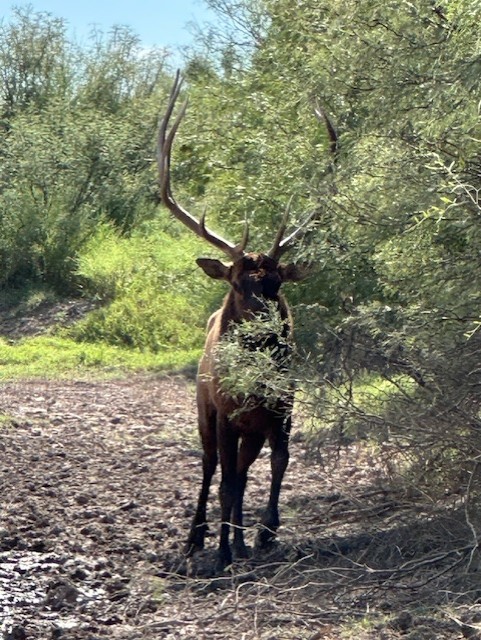
Our forensic analysis concludes that the sinkhole is part of a long fissure that’s opened-up, and we follow it south toward the front of the ranch for about two-hundred yards where it appears to end. In some places the fissure is just a crack in the ground and in other places it opens to as much as a three-foot wide gap that’s six or so feet deep. The interesting thing about the open gaps are that it’s unclear if the earth opened to create the fissure, or if some sort of underground stream has eroded the soil away. Evidence of dirt clumps along the bottom of the trench appearing to be damp suggest the underground stream theory could be valid, however, the side walls seem to present more like the earth opening rather than water eroding, so, there is that.
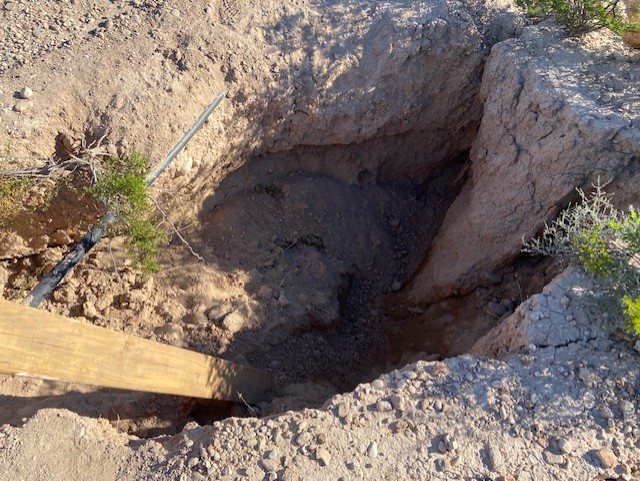
We speculate that if the earth opened to create the fissure, there’s no telling how deep it really is because the dust that’s settled at what appears to be the bottom could just a be a false bonnet hiding the true depth. We throw heavy rocks into the hole to test that theory, but they don’t fall through, which doesn’t mean we wouldn’t if we hopped down to check things out, so we opt not to. Besides, if the earth could suddenly open a fissure of this length and depth, what’s to say it couldn’t just as quickly slam it shut.
With the fissure’s south fork thoroughly vetted, we decide to see how far it extends to the north toward the mesquite grove and start along that fault line. I work myself down the line faster than Lance but stop at a place where the gap opens from just a crack to about twenty-five inches wide. What fascinates me about this gap is it seems significantly deeper than anything we’ve seen thus far, perhaps as much as twelve or more feet deep. Between the sinkhole that tried to eat Jake’s truck and this deep gap, the fissure is mostly just a crack in the ground. Before kneeling to have a closer look, I stop to marvel at the way a sagebrush seems to straddle the crack in the earth just as it starts to open into the twenty-five -inch-wide section. With roots firmly planted on both sides of the crack, it’s as if they were the only thing holding the earth together and I can’t help but wonder if the earth decides to open further and the plant can’t keep the crack from expanding, which side of the line will the plant cast its loyalty.
It’s an interesting thought, the way earth does one thing and nature reacts. Of course, this sagebrush isn’t keeping the fissure from opening further, but if the fissure does decide to open, and the plant must choose a side, does it matter which side? Will it flourish and prosper on one side of the fissure and wilt away to nothing on the other? Is it like being on the north side of the Rio where everything’s good and prosperous versus the Mexican side where hopelessness prevails. Is like being on the Ukrainian or Palestinian side of an arbitrary line on a map versus the Russian or Israeli side. It’s a fascinating dichotomy the way arbitrary lines can decide the difference between life and death, peace and prosperity.
Since one can only stare at sagebrush roots holding the earth together for so long, I scoot down a foot or so to better lean over and peer into the twenty-five-inch-wide gap to see how deep the fissure really is. At first glance it does appear to be at least twelve feet to the false bottom but there does not appear to be any damp soil which would suggest our erosion hypothesis is disproved. About then Lance meanders down to have a look at the deep fissure for himself and as he approaches the sagebrush whose roots are stitching the earth together, the constant competition between life and death catapults into the next microsecond with so much drama, you’d think it would require moments just to be contained.
Lance is about to step around the sagebrush to join my side of nature’s arbitrary line that may or may not have been carved by an underground stream, when from the bush I was just examining there comes the sound of one rattle; not the long melodic warning of a snake hoping to keep you at bay but the single solitude note of a warrior letting you know that time for negotiations have ended and all-out war is the last logical step in a conflict that was never going to be avoided.
In the nanosecond that follows, a four-foot-long rattlesnake springs from the sagebrush bush two feet to my right launching like a long missile heading straight for my face that’s leaning over the fissure to look inside. It’s in this instant I know that later I’m gonna have to thank God for good hearing and great peripheral vision because between the single rattle of a pre-launch missile strike and the time it takes to fly two feet through the air, I catch the movement of incoming fire, or fangs, depending on how I’ll later tell this tale, and pull back from the twenty-five-inch wide fissure just as the snake flies by so close my subconscious counts the number of repeated diamond patterns on the snake’s back before he harmlessly falls through the gap landing twelve feet below me on the chasm’s false bottom, leaving behind a contrail containing the faint wisp of vinegar or piss, I don’t really know the difference.
I look at Lance, who looking at me, before we both stare into nature’s newest rattlesnake pit as one very pissed off snake slithers into his coil, rattling like a madman filled with a vengeance he knows he’s earned. As the last micro moment replays in my head weighing alongside all the ways things could have gone horribly wrong, Lance continues staring at the snake and says in a calm matter of fact tone, “Ya know, if a rattlesnake bites you in the face or neck, you die. There’s no surviving that.”
That’s all that was said about the entire incident because in this part of West Texas along the American/Mexican border just a bit north of Big Bend, it doesn’t matter if it’s the earth wielding its might, nature challenging you to a dual, or mesquite thorns and goatheads stabbing you into submission, absolutely everything is trying to kill you and the best you can do is cheat death one more time and move on.
Lance and I consider retrieving Nick’s shotgun from the pickup and blasting the bastard snake who tried to kill us because in some odd sense of frontier justice, it’s the code of the west and the snake certainly knows that. But ultimately, we decide neither of us is willing to jump down into the hole that is at best twelve feet deep to fetch a snake local chefs claim tastes like piss soaked in vinegar.
If you ever do make your way down to West Texas along the American/Mexican border just a bit north of Big Bend, be careful where you drive and should your car fall into a huge hole that wasn’t there a micro-moment ago be careful getting out and don’t peer too close into neighboring sagebrush bushes, or walk around with thin soled shoes. Make sure you have at least a pistol for feral hogs and probably best you have a snakebite kit and some sort of protection from all the other things trying to kill you. On second thought, you probably oughta just plan on a relaxing weekend at some busy beach because in West Texas, you can only cheat death so long before death balances the ledger of life; after all dear one, that’s the code of the west.

Comments are closed